
The Leash Hypothesis: Why Emotional Pain Evolved
Physical pain kept us alive. Emotional pain kept us in line. A new proposal on why emotional pain evolved, and seven experiments that could prove it wrong.
The meeting is in its fortieth minute, the coffee has gone cold in its paper cup, and you make your small suggestion. A woman two seats down, who does not sign your checks, cannot fire you and will not remember your name by Friday, lets her face change. The change is slight. The corners of her mouth draw in, her eyes go to the window, and a breath leaves her nose with the faint disdain of a radiator. Nobody else at the table appears to notice. Your stomach notices. It drops the way it drops in an elevator that has missed a floor, the heat climbs your neck, and for the rest of the meeting you say nothing. For the rest of the afternoon you rehearse the sentence you should have said and the apology you might still send. At eleven that night, toothbrush in hand, you are still in the meeting. Nobody touched you. No expression on a human face can break your arm, but one can cost you a week.
No expression on a human face can break your arm, but one can cost you a week.
What Physical Pain Is For
We speak of pain as an enemy, and an entire aisle of every pharmacy is stocked on that assumption. The body holds a different view. Pain is the veto the body holds over its own destruction. A hand will leave the stove before the mind has formed an opinion of the stove, and the ankle that hurts is the ankle you stop running on. The clearest evidence for the veto comes from the rare people born without it. In 2006 Cox and his colleagues studied three families from northern Pakistan, each descended from marriages between relatives, in which otherwise healthy people could feel no pain at all, and traced the condition to broken copies of a single gene, SCN9A, which builds a sodium channel called Nav1.7 that the nerves of pain depend on. People born without the veto collect injuries they do not notice from childhood on, and in some forms of congenital insensitivity to pain their lives are shorter.
Physical pain is a sentry with a single employer. Its reports concern your tissue, it fires when your tissue is in danger, and it falls quiet when the danger has passed. You may resent it, argue with it and medicate it, and it will go on telling you, most of the time, the truth about the one thing it was posted to watch.
This pain is yours, and it works for you.
Where Emotional Pain Comes From
In 1978 Jaak Panksepp and his colleagues separated puppies, guinea pigs and chicks from their mothers and listened. The young cried, as separated young do, and the researchers then gave them opiates. Small doses of morphine profoundly reduced the crying of isolated puppies. In infant guinea pigs, doses of a fraction of a milligram per kilogram cut the separation calls in proportion to the dose, and in older guinea pigs the opioid blocker naloxone made the calls more frequent. In chicks, opioid peptides injected into the brain in quantities as tiny as a hundred picomoles quieted the distress at least as potently as the same amount of morphine. The authors suggested that separation distress might be a kind of withdrawal from the brain's own endorphins. That was a hypothesis in 1978 and it remains one. The experiments established something narrower and stranger, which is that the cry of the abandoned young runs, in part, on the chemistry that morphine imitates.
A mammal is born unable to survive alone, so it is born with an alarm that makes distance from its caregiver hurt, and the alarm has one switch that reliably turns it off, which is the caregiver's return. In other mammals the cry does not last. Rat pups begin their isolation calls at two or three days old, call most at seven to ten days, and stop calling at around 17 to 25 days. Infant rhesus monkeys call hardest at about two weeks and then less and less over the following months. Whether the distress itself fades or only the call matures into something quieter, nobody can yet say, and I will not pretend to know.
In human children the alarm has been watched more closely than in any other animal. James Robertson and John Bowlby observed children under three who had been separated from their mothers for days or weeks, in hospitals and residential nurseries with no steady substitute to care for them, and described a sequence in three phases: protest, in which the child cries and searches; despair, in which the crying turns quiet and hopeless; and detachment, in which the child takes more interest in the room and seems hardly to know his mother when she visits. Robertson himself later showed that children cope far better when good substitute care is given, though he held that separation remains a hazard however good the care, which tells you the sequence describes a prolonged and unrelieved separation.
The adult version went into a scanner in 2003. Naomi Eisenberger and her colleagues had thirteen people play a ball-tossing game on a screen with two other players who, after a while, stopped throwing to them, and the exclusion raised activity in the anterior cingulate cortex, a region that overlaps with those active in physical pain, in step with the distress each person reported. Two years later MacDonald and Leary gathered the evidence, much of it from animals, that social and physical pain share machinery, and proposed that the overlap evolved because, for a social animal, exclusion is a threat to life.
Since I am about to ask scientists to hold me to account, I will begin with my own book. In its eighth chapter I wrote that "the anterior cingulate cortex can't tell the difference between a broken bone and a broken heart." Later work says it can. In 2014 Woo and colleagues compared the fine patterns of brain activity in 60 people who were given painful heat and shown photographs of their former partners, and found that the pattern that predicts physical pain did not respond to rejection, even inside the cingulate. A year earlier Iannetti and colleagues had argued that the activity in these regions is largely unspecific to pain and answers many kinds of salient events. The two hurts share an alarm and some opioid chemistry, and the brain tells them apart inside the same regions. The tighter sentence, the one I should have written, is that the alarm demands the same thing of you in both cases: make it stop, now, at whatever price.
This is the first half of the hypothesis: the adult's heartbreak is produced by an organ built for the first two or three years of life.
Why It Fires at Strangers
Among the more humiliating discoveries of modern psychology is that a grown human being can be snubbed by a computer and take it personally. Zadro, Williams and Richardson told volunteers that the other players in their ball-tossing game were run by a machine, and being left out still lowered their sense of belonging, control, self-esteem and meaningful existence. Gonsalkorale and Williams labeled the other players as members of the Australian Ku Klux Klan, and exclusion by the despised group was about as aversive as exclusion by anyone else. Van Beest and Williams arranged matters so that being left out earned the excluded player more money than the others, and ostracism still hurt. These were minutes-long games with strangers, and they tested particular cases: a machine, a hated group and an exclusion that paid. Within those limits the alarm did not care who was sending.
A second finding concerns time. Chen and colleagues asked people to relive past painful events and found that recalling a social hurt brought back more pain than recalling a physical one, and left people worse at demanding tasks afterward. Meyer, Williams and Eisenberger then scanned eighteen people reliving memories about two years old. The original events had hurt about equally, 7.78 for the social and 7.94 for the physical on a scale of ten. On reliving, the social memory came back at 4.53 and the physical one at 3.33. A broken bone can be relived, faintly. A humiliation is relived far more sharply, in the shower, at the stove, at eleven at night with a toothbrush in your mouth.
The standard account treats these results as faults of calibration. The detector, on this view, is oversensitive, a smoke alarm built to err on the side of noise that goes off at burnt toast. I read the same results as a specification. Suppose the alarm was tuned in a band of a few dozen people in which every face belonged to someone who could feed you, shelter you or walk away from you. In that world an alarm has no reason to check the sender, because every sender was a stakeholder, and an alarm that skips the check is cheaper to build and quicker to fire. Such an alarm would answer a computer, a despised stranger and a game that pays you to lose, because it answers the signal and was never fitted with a lock. A punishment meant to change behavior must also keep working after the punisher has gone home, and replay is exactly that: the sentence continues at night, administered by the convict.
This is the second half: the alarm obeys the signal without checking the sender, and it keeps the sentence running after the court has risen.
Claim #1: It Makes Punishment Free
Picture a republic of 50 people with no police, courts or jail. Food is shared, the hunt depends on everyone turning up, and a single man who takes more than his share and does less than his part can ruin the arrangement for all of them. Somebody has to stop him, and stopping him is expensive. The one who confronts him risks a fight, an enemy and an injured hand, and the benefit of his courage is divided among everyone, including the ones who stayed by the fire.
Fehr and Gächter measured the expense in a laboratory in 2002. People in small groups could contribute to a common pot, in what economists call a public-goods game, and after each round they could punish those who held back, at a price paid by the punisher: as the design is usually described, each point a punisher spent cost the punisher one unit and took three from the target. The groups were reshuffled so that no two people met twice, and punishing therefore bought the punisher nothing in the future. People paid anyway, and cooperation flourished when punishment was possible and broke down when it was ruled out. Theorists have worried at this bill ever since. If punishing costs the punisher, then the person who cooperates and lets someone else do the punishing does better than the punisher, and punishment should wither for lack of volunteers. The puzzle, in which the cooperator who leaves the punishing to others rides free on the punisher's courage, is known as the second-order free-rider problem. Boyd, Gintis, Bowles and Richerson showed in 2003 that punishment can evolve in large groups because its cost shrinks as cheaters become rare, and other models have found other routes. The question of who pays, in the species we actually are, is still argued over.
Real bands, when anthropologists have watched them, seldom punish in the expensive way. Polly Wiessner recorded 308 conversations among the Ju/'hoansi and found norms enforced largely by talk and criticism. Richard Wrangham, surveying how foragers deal with a domineering man, puts public criticism, ridicule and ostracism first, and execution only when those fail. Christopher Boehm describes capital punishment among foragers as aimed primarily at "intimidating, selfish bullies." At the end of the road the group uses its hands. Everywhere before that point, it uses its face.
The laboratory has tested the face. Masclet, Noussair, Tucker and Villeval ran the punishment game with points that took no money from anyone and only registered disapproval, and the disapproval alone raised contributions, though by a smaller margin than fines did. A 2024 study found that expressed disapproval held cooperation up only briefly where costly punishment kept it rising, a result I take seriously and return to in the tests.
Evolution, I propose, settled the bill by moving it to the convict. The punisher sends a look, a silence or a tone of voice, each of which costs him nothing to produce, and the target's own nervous system manufactures the punishment, out of the target's own chemistry, at the target's expense and on the target's time. The alarm was already there, built and paid for by every mammal's need to stay near its mother. Keeping it switched on into adulthood, and letting it fire at the displeasure of any member of the band, turned every frown into a fine that the fined person collects from himself. Call it a leash, since it does what a leash does and costs the holder as little. Fehr and Gächter's game shows that the bill exists. The claim that evolution moved it is mine, and it is a hypothesis.
Economists and legal scholars noticed long ago that withholding esteem costs the withholder nothing. Jon Elster described social norms as sustained by the embarrassment, anxiety, guilt and shame a person feels at the prospect of breaking them, and Richard McAdams built a theory of norms on the fact that refusing esteem can hurt others at no cost to the one refusing. Herbert Gintis modeled how the capacity to internalize norms, enforced by shame, guilt and loss of self-esteem, could be selected, and with Samuel Bowles argued in A Cooperative Species that the social emotions made ethical conduct a personal goal. Boehm traced conscience to the punishment of bullies, and Wiessner documented how foragers actually punish, mostly with talk. Nietzsche, in the second essay of his Genealogy in 1887, claimed that guilt began as debt, a point he hung on the German word Schuld, and wrote that "All instincts which do not find a vent without, turn inwards." My own book, in its first chapter, calls social media "a voluntary Panopticon where you guard yourself."
What is added here is narrower than any of them. That the sting of disapproval makes punishment cheap is an old idea. The step proposed here is that this cost shift is why social pain was kept, the reason the infant's alarm was never retired. I have not found anyone who states it so, and I would be glad to be shown the paper.
You are, on this account, the only prisoner in history who pays the jailer's wages.
Claim #2: We Bred Ourselves to Keep It
The self-domestication hypothesis holds that our species tamed itself, and its leading authors describe the taming in three ways. Brian Hare calls it selection for prosociality: late in human evolution, he argues, natural selection favored friendliness within the group over aggression, and the physical marks of domestication followed as by-products. Wrangham describes the same history as selection against reactive aggression, carried out by coalitions that killed the domineering. Boehm calls it selection against bullies. On the accounts of Wrangham and Boehm, the bands killed or expelled the adults they could not control, the hot-tempered left fewer descendants, and the standard reading is that this bred aggression out of us.
I propose that it bred something in. On this account, the trait the bands selected was the lifelong retention of the infant's separation alarm, with its trigger widened from the mother's absence to anyone's displeasure, and lower aggression followed from that retention as its consequence. An adult who can be hurt by a frown is cheap to govern. He seldom needs to be killed, because he can be corrected first, and the punishments in Wrangham's sequence come in exactly that order: criticism, ridicule and ostracism, with execution held back for the man they fail to reach. A temperament that felt the first three as pain would be the temperament that survived them.
The timetable fits. In societies that do not limit births, humans wean at about two and a half years, and chimpanzees at about five. A human weans the stomach before three and never weans the alarm.
If the retained alarm is the trait that was selected, some people should be born with a weak one, and the arrangement should treat them differently. By the strict clinical checklist, about 1.2% of adults in the general population meet the definition of psychopathy; a pooled figure across looser measures is 4.5%. Kiehl and Hoffman estimate that psychopaths are 20 to 25 times more likely than other people to be in prison. Gintis's model expected them, noting that in some sociopaths the capacity to internalize norms is diminished or lacking. The people the cheap signal never reached get the expensive punishments. Walls, guards and locks are what a society spends when a frown has failed.
The proposal can also be checked against our relatives. Field workers have long reported that other apes are distressed by the loss of a bonded companion, and nothing here disputes it. The claim made here predicts that only humans are hurt by the disapproval of strangers, and that is a test a primatologist could run.
Please note, the pieces of this argument belong to others. Self-domestication belongs to Hare and Wrangham. Docility belongs to Herbert Simon, who argued in 1990 that people who readily accept what they are taught can be loaded by their society with duties that serve the group. Adult love as retained infant attachment belongs to Cindy Hazan and Debra Zeifman, and to Chris Fraley's comparison across mammals, which ties adult attachment to retained juvenile development. Social pain as a borrowed attachment alarm belongs to Panksepp and Eisenberger. What is added is the claim that the retained alarm, its trigger widened from the caregiver to the group's displeasure, is the trait self-domestication selected.
In short, the species is an animal that was never allowed to grow up, and it calls the arrangement manners.
How We Numb It: Obedience
If the alarm is what I say it is, people will have found ways to quiet it without removing it, and they have found three. The first is to agree.
The people around the table have settled on a view, you hold another, and before you have opened your mouth your chest has tightened, and your fingers have found something to do with a pen. Klucharev and his colleagues watched the brain at this moment. People rated the attractiveness of faces and were then told how the group had rated them, and when the two disagreed, the clash produced a signal in two brain regions, the rostral cingulate zone and the ventral striatum, resembling the error signal the brain uses to learn from a mistaken prediction. The size of that signal predicted who would change their rating to agree. In a later study the same group dampened a neighboring stretch of brain, the posterior medial frontal cortex, with magnetic pulses, and conformity fell, by a small amount.
The brain, on this evidence, treats disagreement with the group as an error, and the fastest correction available is agreement. On the reading I am proposing, the 'yes' is what ends the signal.
Read Milgram's obedience experiments with that in mind. In the best-known version, 26 of 40 volunteers, 65%, went on delivering what they believed were shocks to the full 450 volts, and the figure moved a great deal as he varied the setup. When Jerry Burger repeated the experiment in 2009, he stopped it at 150 volts, the point at which the learner first protests, and 70% of his base condition were willing to go on past it; nobody was taken further. These experiments are usually read as studies of cruelty, and they can also be read as studies of relief. Each refusal would have cost the volunteer a confrontation with the one person in the room who held its authority, and each press of the switch bought a few seconds of peace from that confrontation. The man in the gray coat needed only to say "please continue," and the volunteer's own alarm did the rest.
The book says it more briefly. "Obedience is psychologically sedative," runs a line in The Contract, and a few paragraphs later: "You are addicted to permission." The same chapter puts the arrangement in one sentence that I would now sign with a citation beside it: "They've never had to put a gun to your head to make you obey." The compliant are sedated, and the sedative is permission.
Your Favorite Psychoactive Drug
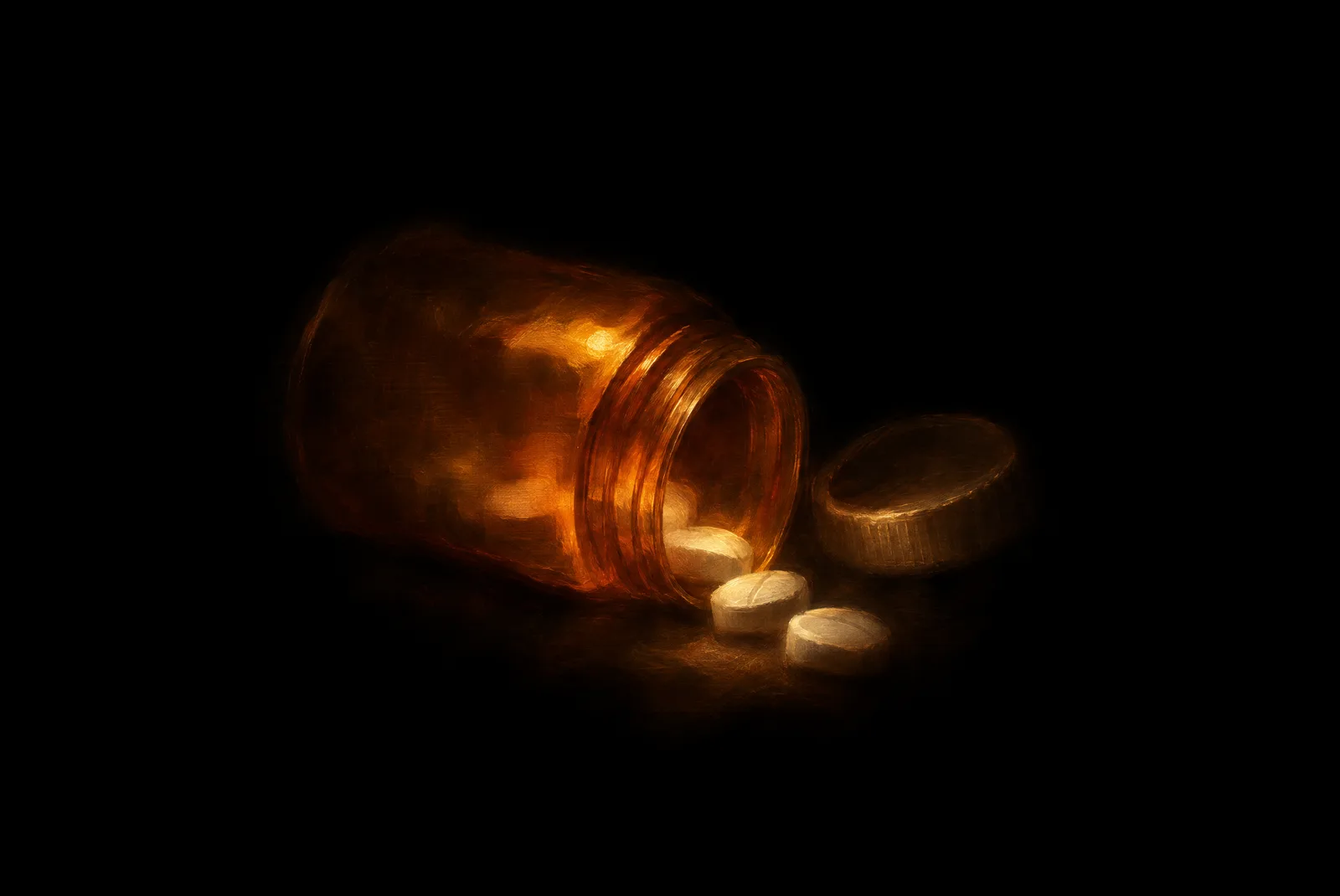
Caffeine will object to this heading, with some justice, but caffeine at least admits what it is. What can be defended is that acetaminophen, which most of the world calls paracetamol, is one of the most widely used drugs on earth, and that nobody can say how it works.
In 1886, in Adolf Kussmaul's clinic in Strasbourg, by the usual retelling, a patient was meant to receive naphthalene for worms and was given the wrong powder, acetanilide, and his fever fell. Cahn and Hepp, who reported it, called the discovery a fortunate accident and the drug Antifebrin, and the next year a cousin, phenacetin, arrived to replace it. After more than a century of use, a review in 2021 could still say that the precise mechanism of action of this familiar drug remains a mystery. In 2025 Maatuf and colleagues found, in rats and in cells, that a product of the drug's breakdown, AM404, is made in the pain-sensing nerves themselves and blocks their sodium channels, Nav1.7 among them, the channel the Pakistani families were born without a working copy of. It is a strong lead, but the mechanism is still unsettled.
What the drug does to people who are not in pain is the stranger story. DeWall and colleagues gave 62 healthy students either 1,000 milligrams of acetaminophen a day or a placebo for three weeks and asked them each evening about hurt feelings. Hurt feelings fell over the three weeks on the drug and did not change on placebo, and by the twenty-first day the groups differed, though the difference between the two trends was only marginal. In a second experiment 25 students took 2,000 milligrams a day for three weeks and were then excluded in the scanner, and their brains responded less to the exclusion in the cingulate and the insula, while the distress they reported was the same as the placebo group's. Durso, Luttrell and Way found that the drug made unpleasant pictures less unpleasant and pleasant ones less pleasant, flattening both ends of the scale. Mischkowski, Crocker and Way found that it reduced empathy for other people's physical and social pain.
These effects are small, and much of the evidence comes from one laboratory and its collaborators. A large null result, Garrison and colleagues' study of 173 students in 2021, found no effect of the drug on the electrical brain responses it was able to assess. In 2026 Hartmann and colleagues pooled fifty studies of drugs and placebos that dull pain and found their effects on social emotions inconsistent, small and running in both directions. DeWall's three-week result itself rests on a marginal difference. In short, I am building on ground that may give way, and I would rather say so before a reviewer does.
As for the pain the pill is sold for, the record is mixed. In a trial of some 1,650 people with acute low back pain, those taking the drug regularly recovered in a median of 17 days and those on placebo in 16. It brings down a fever, and doctors rely on it for pain after surgery, and the warning about the liver printed on the packet is the doctors' own. Nothing in this section is advice about what anyone should take.
Morphine quiets the separated puppy, and the pill in the bathroom cabinet may quiet the governed adult, a little. If so, scientists should stop measuring whether the painkiller works and measure who it works on.
The experiment is cheap. Put people in a cooperation game in which some rounds allow only costless disapproval and others allow fines, and give half of them acetaminophen and half a placebo. The prediction is that the drug weakens the deterrent of disapproval, leaves the deterrent of fines untouched, and does its work in the people who score high on rejection sensitivity, a trait that questionnaires measure by asking how readily a person expects and dreads being turned away.
The body keeps a version of its own. DeWall and Baumeister found in 2006 that people told to expect a lonely future grew less sensitive to physical pain and less moved by another person's breakup or broken leg. Exclusion itself produces numbness, to pain and to other people, which is the alarm's last resort when the band has already shut the door.
Three anesthetics for one alarm, the yes, the pill and the closed door, and none of them takes the alarm away.
Claim #3: It Can Be Weaned
The pain of disapproval is manufactured by the person who suffers it, and so it is the one pain that person can stop producing. A broken arm hurts whatever you think of it. The frown from two seats down cost the woman who made it nothing, and everything it cost you was drawn from your own account, in your own chemistry, which means the account can be closed. The closing is a weaning, and like every weaning it is done by acts, repeated against protest. A child who understands perfectly well that the breast is gone still cries for it, and understanding has never weaned anyone.
The 21-day protocol in The Marble Statue is a weaning schedule written before I had the word for it. Day 1 asks for a ledger in two columns, one headed "The Bleeding," for every moment you absorb another person's state, and one headed "The Feeding," for every moment you inject your own story into theirs. Day 2 imposes a rule called "No Self-Reference," which removes personal anecdotes, comparisons and unrequested advice from your conversation. Day 4 asks you to listen while someone digs into an old hurt and to "Offer zero comfort, or healing, and definitely no advice. Simply witness their excavation." Day 5 sets the mean between coldness and fusion and asks you to write: "I neither become nor abandon. I witness with warm precision." Each day withdraws a supply. The ledger shows you where you go looking for approval, the rule of silence stops you asking for it, the witnessing removes the reward of being the one who soothes, and the mean closes the escape into coldness.
The Parasite adds the irreversible act, one move that cannot be taken back, and predicts what follows it: "panic first, the nervous system discovering the door has been taken off its hinges and demanding it back," and then, if you hold, "the silence, the first quiet in years." That is the separated infant's protest, scheduled and survived.
The book also says in advance what the weaning will feel like, because a person who is not warned will take the symptoms for failure. The reader it imagines writes, "I'm exhausted. Something feels wrong with me," and then, "This feels worse than before I started," and the book answers the second plainly: "It is meant to." The reader cries for no reason she can find, sleeps badly and feels anxiety come and go without cause, and the explanation the book gives is the one this essay has been building: "The nervous system reads a change of identity as a threat to survival."
One limit must be drawn plainly, because many of the people who read this live on the far side of it. Where the dependence is real, where another person holds your money, your children or the threat of violence over you, the alarm is reporting accurately, and nothing in it needs weaning. The work in that case is a plan to leave, made with help. The weaning described here is for the leash that is tied to nothing but approval. A leash that runs to nothing real can be let go, one act at a time.
What My Readers Show
By the time a reader posts about day nineteen, the hard part is behind her and the record of it is already written, scattered across thousands of posts in the readers' own communities and in published reviews. I gathered that record and counted it. Every post about the protocol, every post by the readers who could be followed on both sides of it, and every published review, 6,519 texts in all, was stripped of names and then judged, one by one, by a language model working from a fixed rubric that asks what state a text describes, whatever words it happens to use.
Of the 951 posts written in the first week, 12% show protest: guilt at not rushing in to comfort someone, loneliness at not being heard, a hurt felt in the present, a need for approval felt in the present. In the second week the figure is 8.6%, and in the third, 3.1%. Detachment, the coldness the book warns against, moves the other way late in the protocol: it stands at 2.2% of posts in the first week and 1.6% in the second, rises to 3.8% in the third, and falls to 1.2% in the later posts of the 201 readers followed for more than three weeks past their protocol. Posts that describe being settled and needing nothing back rise from 8.4% in the first week to 13.5% in the second and 20% in the third. Posts that describe reading other people more sharply go from 15.1% to 23.3% and then 21.9%.
Set beside Robertson and Bowlby's children, the shape is familiar. Protest comes first and fades. A passage through coldness follows, late, and then recedes. After it comes a new footing, of the kind that Bowlby and Colin Murray Parkes described as the last phase of mourning, which they called reorganization. The rubric did not code for despair, so the middle of the infant's sequence is missing from this record, and I make no claim about it. The book names the cold as a station on the road, in its answers to readers' questions: "If you've gone cold and called it sovereignty, you've confused the destination."
Each phase of this reading has a precedent. The separated children's protest, despair and detachment belong to Robertson and Bowlby. The mourners' reorganization belongs to Bowlby and Parkes. The behaviorists' extinction burst, in which a habit flares when it stops paying, would by itself predict the early protest, and that simpler account deserves to be beaten before mine is preferred. What the extinction burst does not predict is the late cold phase and its passing, and that is what the readers' record shows. On the other side of the table, Harriet Lerner described the countermoves by which the people close to someone who changes tell her to "change back," a phrase I owe to Lerner alone, and I have argued elsewhere that your family will punish you for getting better.
One reader described the old condition in capitals: "THE REMOTE CONTROL OF MY SELF ALWAYS IN SOMEONE ELSE'S HAND." Six months in, she wrote: "I'm the owner of my thoughts and feelings, deciding what affects me and how much. The world hasn't changed. The circumstances haven't changed. Yet everything is different." Another wrote: "I was always pouring myself out into empty cups. I never realized how that opened me up to be an easy target for manipulation." And another, at day 19, put the old condition into one plain admission: "I also only communicated for validation or attention."
A second pass over the same record, which had grown to 6,599 texts, asked what the people around the reader did, and what the readers said about the source of their hurt. In 16.2% of first-week posts, 16.3% of second-week posts and 9.9% of third-week posts, the reader says, in some form, that the hurt was produced by her own reading of the moment, and that the other person had not caused it. That is 1 post in 6 in the first two weeks. The readers were stating the premise of the weaning before anyone had asked them to.
Posts describing a disapproval signal that no longer worked on the reader (a look, silence or guilt trip that fell flat), rise from 0.4% in the first week to 0.8% in the second and 3.7% in the third. Posts describing other people pushing back harder, with anger, accusations of coldness or selfishness, or the silent treatment, hold at 2.4, 2.0 and 2.5%. That is flat. The prediction that the people around a weaning reader escalate as the weeks pass is not borne out by the weekly shares. A conditional figure points the other way: only 32 posts in the whole record describe a signal that failed, and 15 of those 32 describe, in the same post, the other person escalating. Thirty-two posts make a hint, and a hint is all I claim. Posts describing other people responding with more respect, or backing down, run at 4.0, 2.4 and 6.2%, and across the whole record 125 posts describe respect and 102 describe escalation.
The limits must be stated before anyone else does. These are the readers who chose to post, and the readers who quit do not write on day nineteen. There are 951 posts in the first week and 160 in the third, so the late weeks speak for the people who stayed. The judge was a machine reading text. Nothing in the body was measured, neither cortisol nor heart rate. There is no comparison group of people who spent three weeks doing something else, and some part of this curve may be what any three weeks of attention to oneself would produce.
This is testimony, counted, and testimony is what a laboratory exists to test.
Experiments To Prove Me Wrong
If you run a laboratory, this section is addressed to you, and the hypothesis is yours to break. Seven tests follow, each with the result it predicts.
- The replay. Put adults through a 21-day cut of appeasement and approval-seeking and measure cortisol and heart rate throughout. The prediction is protest first, then a passage through detachment, then a settled footing, visible in the body as well as in the diary.
- The cost shift. In a public-goods game, set costless disapproval against fines, sort the players by rejection sensitivity, and run the game with acetaminophen and with placebo. The prediction is that people high in rejection sensitivity are deterred by disapproval, people low in it need fines, and the drug weakens the first deterrent and leaves the second intact; the 2024 finding that disapproval fades should be tested for whether it fades fastest in the least sensitive.
- The lock. Exclude untrained people and people who have done the weaning, once by senders with no power over them and once by senders who hold something real. The prediction is that the untrained hurt equally at both, and the trained hurt only at the sender who holds something.
- Escalation. Follow groups in which one member stops responding to cheap signals. The prediction is that the others reach for costly signals, then either respect the member or expel him; my readers' weekly figures do not show it, and the test needs observers who can watch both sides.
- The comparative test. Grant that other apes are distressed by losing a bonded companion. The prediction is that no other ape is hurt by exclusion at the hands of strangers as humans are.
- The genetic test. Look for variants swept during the window of self-domestication and test them against rejection sensitivity, with the gene for the mu-opioid receptor, the receptor morphine acts on, as a first candidate and nothing more: Way, Taylor and Eisenberger linked a variant of it to sensitivity to rejection in 122 people, 31 of them scanned, a result its authors call suggestive until replicated.
- The ungoverned minority. People born with a weak alarm should draw the costly punishments in every society that keeps records, and their excess in prisons should track a measured weakness of the alarm itself.
Three results would sink the hypothesis. If other apes are hurt by strangers as we are, the trait is older than our self-domestication and the claim about what self-domestication selected falls. If the replay fails to appear in the body, the readers' curve is a story people tell about themselves and the claim about the weaning falls. If rejection sensitivity fails to predict who is deterred by a costless signal, the cost shift loses its hinge and falls with it.
The ingredients belong to others, and I have named them as they arose. What I offer are the three claims stated at the start, each a hypothesis: that the cost shift is why social pain was kept; that the retained alarm, its trigger widened from the caregiver to the group, is the trait self-domestication selected; and that an adult who stops seeking approval walks the separated child's road, protest and then a passage through detachment, and comes out, as mourners do, reorganized. I have not found these stated before. The search behind that sentence was one sweep per claim, and several of the books it most needed to read were out of its reach, so I repeat the offer: I would be glad to be shown the paper.
A hypothesis owes its testers the ways it can die, and this one has named three.
What is Made Can Be Taught
We like to believe that adulthood arrives on a birthday, with a key to a car and a name on a lease. On the account given here, selection arrested our development, and the arrangement has outlived its reason. Exile from a band of fifty was death. The alarm still charges that price for a frown from a stranger who has nothing to give you and nothing to take. Adulthood, then, is made, by weaning, and the calendar has little to do with it.
A child at a kitchen table learns it the way children learn everything that matters, by watching: a parent who hears the neighbor's sniff over the fence and goes on buttering the toast is giving a lesson that no lecture can give. That inheritance is cultural, passed by example from one table to the next, and I make no claim about genes.
What remains after the weaning is the bond without the leash. The weaned adult still loves, and loves with more freedom, because the warmth is chosen. That chosen warmth is what the readers called settled, needing nothing back, and kindness begins there. The sedated agree because agreement stops the pain. The weaned are kind because they decided to be, and their kindness can be declined without injury to either party.
Back at the meeting, the woman two seats down lets her face change again. The corners of her mouth draw in and her eyes go to the window. Your stomach stays where it is. You register the frown the way you would register rain on the glass, ask yourself whether she holds anything real over you, find that she does not, and finish your sentence. The face changed, and this time it arrived as information.
This essay proposes a hypothesis, and the hypothesis itself has not yet been tested in a laboratory. The reader data are testimony, counted with care and with every limit stated above. The numbers and the method are available to any researcher who writes to hello@stantaylor.com. Where I am shown to be wrong, the correction will be printed here.