
Your Family Will Punish You for Getting Better
On the punishment that follows your recovery, why it is loudest just before it ends, and whom to bring with you.
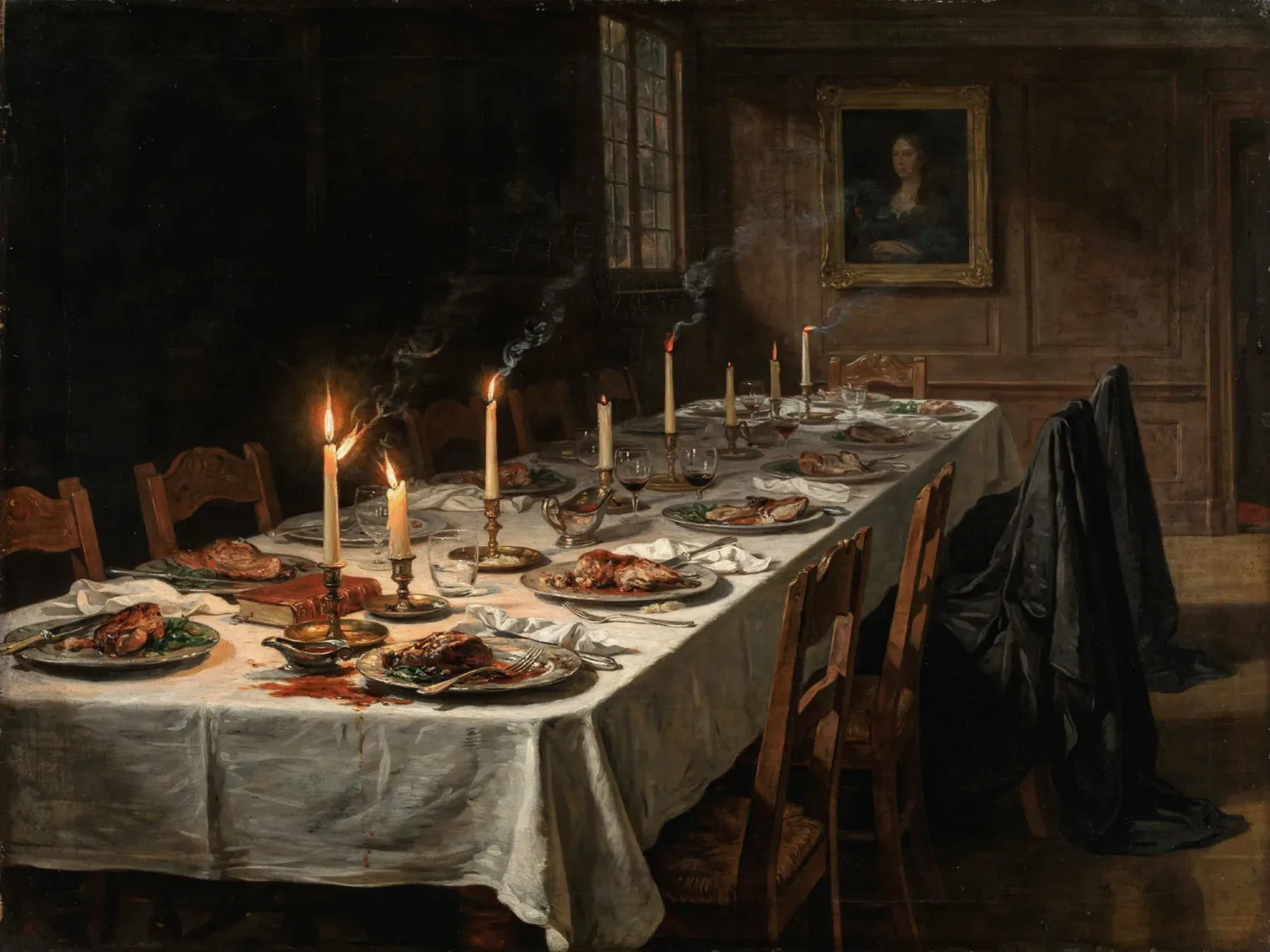
The gravy travels the table clockwise every Sunday, and for thirty years it has stopped in front of you, because you are the one who ladles it onto everyone else's plate. You also refill the water, laugh at your uncle's joke about the government, change the subject when your brother-in-law starts on the immigrants, and ask your mother about her knee before anyone can ask her about anything else. These duties were assigned by repetition and never in writing, until the furniture itself remembers who sits where.
Next Sunday, the gravy arrives, and you serve yourself and pass the boat along without a word. You let the uncle's joke land on silence. When your mother begins the familiar sentence about how nobody calls her anymore, you decline to rush in and fill it, and you ask her, with real curiosity, what she means. The room registers the change before you have finished registering it yourself. Forks slow. Your sister looks at you the way one looks at a smoke alarm sounding with no visible fire. Within the hour someone will ask whether you are feeling all right, and the question will be put with such tenderness that you will very nearly answer it.
Your one offense is a resignation. You have left a post without notice, and the family, like any institution that loses an officer that way, has opened an inquiry into the desertion.
A Thermostat Has No Opinion of You
In 1957 a psychiatrist named Don Jackson published a short paper with an unglamorous title, The Question of Family Homeostasis, and it ought to be read aloud at every wedding. Jackson and the other early family therapists had been treating patients one at a time and noticed that when one member of a family got better, another frequently got worse. In the case one standard family-therapy textbook still retells, a depressed woman began to recover, and her husband complained that she was getting worse. That textbook states the moral as "Even positive change can be a threat to the defensive order of things." Jackson's idea, family homeostasis, is usually explained with a thermostat: the family behaves like a heating system that holds its temperature by pushing back against any change, in either direction, and the push is no respecter of whether the change is a fever or a cure.
Murray Bowen, working in parallel, spent two decades building a theory of the family as one emotional unit, in which each member's behavior is a part played inside a larger arrangement, and a part abandoned by one player must be covered by the others or the whole production stops. The Black Book of Power calls the script of that production the Contract, and it insists, with some cruelty, that you co-signed it: "The contract of obedience was signed by two parties, and one of them was you." The signature was given in childhood, before you could read the terms, in exchange for the only currency a child accepts, which is the continued affection of the people who feed it. The book's first chapter names the parts the contract hands out, the peacemaker and the responsible one, the golden child and the scapegoat, and observes that the favored roles are cages too: "Those pedestals they put you on were still cages."
My readers have written to me, about me and to one another more than 21,000 times, and I read those messages closely for this kind of question. Family runs through thousands of them. Hundreds describe the moment the family pushed back against a change, others describe a relative cut off or a reader cut off by one, and many more of the messages about relatives mention guilt. The numbers are small beside the whole, but the pushback stories share one plot: the family noticed at once, and treated the change as a malfunction.
A thermostat knows one fact about you, and the fact is that you were the setting.
The Error in Their Heads
Watch your mother's face in the half second after you decline the old role, before she has decided what she thinks about it. The eyebrows lift, the mouth opens slightly, the head tilts back as if a step she expected were missing from the staircase. This is the face of a prediction failing. A leading school of neuroscience has spent three decades arguing that the brain works as a forecasting machine, constantly guessing what will happen next and attending most sharply to the gap between the guess and the event. Your relatives carry a model of you more detailed than any you carry of yourself, refined over decades of Sundays, and when you behave outside it you register in their heads as an error. In this account the brain works to remove an error, and it has two ways to do it: revise the model, which is slow and costly, or correct the world until it fits the model again, which is quick and requires only that you change back.
To the people applying it, the correction feels like the restoration of something obviously right, which is why it can be applied with a clear conscience and a second helping. The hand that steers you back to your old chair is the hand that once buttoned your coat, and nobody at the table has ever had to tell the two motions apart. The pressure you feel in return has an address in the brain. In a now-famous 2003 experiment, Naomi Eisenberger and her colleagues had volunteers play a ball-tossing game in a brain scanner while two other players quietly stopped throwing to them, and the exclusion activated the anterior cingulate cortex, a region that also responds to physical pain, in step with the distress the volunteers reported. How closely the two kinds of hurt share their wiring is still argued over, though few dispute that they overlap in broad regions of the brain. Kipling Williams, who invented the game, found a sequel that every scapegoat will recognize: people who had just been left out were more likely to conform on the next task. Exclusion is a lever, and its purpose is to move you back into line. Psychologists who study ostracism argue that belonging is wired as a matter of life and death, since for most of human history a person expelled from the group was in mortal danger. When Gregory Berns put people in a scanner and pitted their own judgment against a unanimous group, the ones who held their ground showed increased activity in the amygdala, the brain's alarm, which the authors read as a sign of how charged it is to stand alone.
Social psychology adds a finding that any family's black sheep could have supplied without a grant. In 1988 José Marques and his colleagues documented what they called the black sheep effect: we judge members of our own group more extremely than outsiders, and the disliked insider worst of all. A later study found the harshest verdicts reserved for deviants who were full members of the group; newcomers who broke the rules were socialized, and full members were punished. The guest who declines to serve the table is merely odd. The child of the house who declines is a traitor, and the severity of the verdict is a measure of how much the group had invested in that child's compliance. Your relatives are defending a forecast, with the energy of people protecting their own sanity, which in a sense they are.
Every Pattern Screams Before It Dies
The child who always got the sweet by whining, and now does not, whines louder and longer and then throws himself on the floor before the behavior finally gives up. Behavioral psychology calls this the extinction burst: a behavior that stops being rewarded escalates before it dies, and anyone who has ever stopped answering a particular telephone call has heard one. In one analysis of 113 clinical cases it appeared in about a quarter of them, and in only 12 percent when the treatment also rewarded something better in the old behavior's place, against 36 percent when it did not. Remember that second finding, because it is the beginning of the cure.
Your family's old methods worked on you for years. The sigh brought you running; the silence produced your apology; the remark about how hard your mother's life has been bought your afternoon. Now the methods have stopped paying, and so, for a season, they will be used more often and at greater volume. The most reliable enforcer the family employs is the one it installed in you, which is why the guilt so often arrives on Sunday night before anyone has picked up the phone. Harriet Lerner, in The Dance of Anger, called these responses countermoves, "the other person's unconscious attempt to restore a relationship to its prior balance or equilibrium," and summarized their message in two words you will hear in a relative's voice: change back. She added that countermoves are "an expression of anxiety, as well as of closeness and attachment," and that the work is to keep clear about your own position while they happen, which is harder than it sounds and the only thing that works. The Naked King stages the same scene in almost the same words: "The first few times you enforce a boundary with a family member who's never seen you do that, it might shock them. They may push harder or guilt-trip," and the guilt usually arrives as a single accusation, you've changed. "You hold the line calmly. Soon they realize the old games won't work, and either adapt or fade."
The accusation deserves a moment of forensic attention, because the family that makes it is testifying against itself: it admits that it noticed, and that it preferred the earlier model. The book's chapter on villains, The Enemy's Gift, translates it exactly: "'You've changed' is the past self becoming the villain to present conflict." The family had a version of you that suited it, and the new version is being prosecuted for the crime of replacing it. The same chapter gives the motive with a coldness I cannot improve: "The family needed a villain more than it needed health, so it created one from its most vulnerable member."
The escalation rarely arrives through the front door. Bowen called the mechanism the triangle, and the Bowen Center puts it plainly: "a two-person system is unstable because it tolerates little tension before involving a third person." You refuse one relative, and that relative files the reply with another, who delivers the verdict as if it had been reached independently. Our readers' messages describe the same choreography: the refusal goes to one relative and the punishment comes back from another.
Escalation is the sound a contract makes when it expires. The loudest week is usually the last one.
The Theater of Concern
Erving Goffman, the great sociologist of embarrassment, divided social life into a front stage and a back stage: the front, where we perform the self the audience expects, and the back, where the performers drop their characters and, in Goffman's words, the impression fostered out front "is knowingly contradicted as a matter of course." Goffman's word for people who stage one performance together was a team, and families are the most accomplished teams in existence, having rehearsed the same play for generations. Once you leave your part, you will be given a rare privilege, which is to watch the company perform for you.
The performance takes three forms, and you will meet all three, the last of them behind your back. The first is sorrow, offered in your presence, with a lowered voice and a hand on your arm: we are worried about you, you seem so different, this is not like you. The second is questioning, a cross-examination in which every answer is entered into evidence and none is wanted. The third happens where you cannot see it. Your relatives will discuss you among themselves, on the telephone and in the group chat that was created without you, and they will arrive at a shared account of your decline before you have heard a word of it. The Power Webs, the book's chapter on networks, describes the mechanism: your absence gets explained "by a rumor you can't catch because it wears a different face in each corner of the web."
Anthropologists and psychologists keep finding this machinery, from hunter-gatherer bands to laboratory games. Christopher Boehm, working on hunter-gatherer bands, found that teasing, then shunning, is how the band cuts an ambitious member down to the common size. In experiments by Matthew Feinberg, Robb Willer and Michael Schultz, people who heard gossip about a selfish player shut him out, and the excluded player came back cooperating. Robin Dunbar estimates that about two-thirds of human conversation is devoted to social topics, most of it gossip, and suggests that one of its oldest functions is policing the members who break the rules. The family group chat is a tribunal with emoji, and its jurisdiction is the old version of you.
The sorrow needs the most careful handling of the three, because sometimes it is real. Psychologists who reviewed the research on guilt found that it is strongest and most common inside close relationships, where one of its purposes is "enabling less powerful partners to get their way." A more recent line of studies describes what its authors call the virtuous victim signal, and finds that the display of suffering combined with moral goodness can draw resources from others to the person displaying it. The book's catalog of emotional plays describes the Pity Play in one line: "Instead of making you fear them, they make you fear for them." It also concedes, honestly, that "this is tough because real suffering might be involved," and gives the test that separates the two: "If the person's distress only surfaces when they want something or are confronted, that's suspicious." Sorrow that appears only on the evenings you hold your position is a performance with a box office. Sorrow that was there before you changed is a human being in pain, and deserves your attention for its own sake.
Here the discipline of the Marble Statue earns its name. The statue "feels everything that arrives and then chooses, deliberately, what it will permit to move it." You will see the lowered voice for what it is, and the hand on the arm, and the glance exchanged between your sister and your aunt across the kitchen, and you will feel each of them, and none of them will move you. The Halo Effect gives the instruction for the moment, and it is short enough to remember under fire: "You'll want to justify. Don't. Brevity is your blade." Three short sentences from the book's counter to the Pity Play will carry you through the evening: "I'm sorry you're in pain. I care about you. However, I still can't do X right now." You say them once for each provocation, in the same tone each time, and you leave when you said you would.
One reader admitted in a published review to having run the same theater in the other direction for years. "Normally I'd inject my story and make it about my experience. Perform parental wisdom right? This time I just asked probing questions and shut up. He actually opened up for the first time in months." That is the Marble Statue applied at home, and the review carries a second lesson under the first. The parent had been feeding, the book's word for inserting yourself into another person's moment for a payoff of your own, and the son had been starving. The performance of wisdom had been standing between them for years. The theater runs in both directions, and the first performance you are obliged to cancel is your own.
Some Will Attempt To Recruit You
Before going further I owe you a warning, and it applies to me as much as to anyone. One of the oldest tricks in the recruiting manual of every cult is to convince the convert that his family's objections are proof of his progress. The Black Book of Power lists the move in its chapter on false prophets, Gods and Monsters, among the scripts a predator uses to keep a follower from leaving: "Your family's concern shows they're still asleep." It lists the companion move as well: "Family concerns reframed as 'spiritual attack.'" And its chapter on persuasion cascades describes how a recruit gets locked in: "He gets into arguments with friends and family, defending his new beliefs. Each argument is a Public Commitment, burning the bridges back to his old life."
So hold every teacher, including this one, to a simple test. A teacher who wants you closer to your family, steadier in their presence and harder to manipulate by anyone, including him, is giving you your life back. A teacher who wants you farther from your family, defending him at their table and isolated with him, is taking your life for himself. The book's own answer to the reader who has cut everyone off is a rebuke: "If you find yourself cutting everyone out and calling it standards, redo Chapter 4 with a focus on the Aristotelian Mean."
Your family may be punishing you for getting better. Make very sure, before you conclude it, that you have.
Contempt Is the Relapse
You see your father's anecdote coming three sentences before he reaches it, and you see the need underneath it, and you see your sister flinch at his voice exactly as she did at nine, and you notice that you are no longer flinching, and the noticing is delicious. The temptation arrives about a month after the old role is put down, and I know it because I have felt it: it begins as clarity and curdles into pleasure. One reader described where it can begin, with an honesty I admire, in a published review written after the first four chapters: "I have been feeling negative, irritable and resentful of some of my family and friends that I'm seeing in a different light."
The diagnosis sits in the questions and answers at the end of The Marble Statue, beneath the line "I feel above people now," and it is unsparing: "The aim of this chapter was never to make you cold, and the contempt you now feel for the unconscious people around you is not sovereignty. You have overshot." The pendulum that once had you fused with every feeling in the house has simply swung to the opposite wall. Contempt is the old pattern running in reverse: where you once bled for them, you now feed on them, and the feed in question is the oldest and cheapest of all, the sensation of being better than the people who raised you.
Nobody has measured the cost of contempt more patiently than John Gottman, who spent decades filming married couples and following them for years afterward. Of the four behaviors he found most destructive to a relationship (criticism, defensiveness, stonewalling and contempt), his institute calls contempt "the single greatest predictor of divorce." Other researchers have shown why. Anger, for all its noise, tends toward later reconciliation; contempt is characterized by rejection and social exclusion. The angry relative may still come to dinner. The contemptuous one has already left. Contempt is the conviction that the other person is beneath you, and it corrodes a family as surely as it corrodes a marriage, because it can be felt at the table even when nothing is said. Nietzsche made a philosophical term of its sour cousin, ressentiment (rendered resentment in the old English translation), the revenge of the weak who cannot act and so console themselves with moral superiority, and it is a melancholy irony that the newly strong so often reach for the same consolation. Ressentiment cannot survive without the thing it resents, and so the person who sneers, for all the airs, has never left the table and has only changed seats.
Marcus Aurelius, who ran an empire and had as much reason as anyone to despise the people around him, began his days with an exercise worth stealing. He reminded himself each morning that he would meet the meddling, the ungrateful and the arrogant, and that they were that way out of ignorance, and then he drew the conclusion that matters here: he could not be angry with his kinsman, nor hate him, "for we are made for co-operation." Seneca, writing to a friend about the crowd, gave the same instruction from the other side: "you should not copy the bad simply because they are many, nor should you hate the many because they are unlike you." The closing pages of the book reach the same verdict by a shorter road: "The people still trapped in their programming are you from before. You were predictable and manipulable, signing contracts you couldn't see." And in The Strings of the Heart, its chapter on the hungers, the book states the practical consequence: "Contempt doesn't break the spell."
The sneer is the parasite's last disguise, and the most flattering one it owns. The family you despise cannot follow you anywhere.
The New Arrangement
In the second or third month, without your permission and without anyone having warned you, the family reorganizes. Someone stoops for the duties you put down. Your younger brother begins refilling the water; your aunt takes over the work of changing the subject; the role of the family's worried one, which you held for a decade, passes to a cousin who seems almost relieved to have it. Bowen's theory holds that a change in one person's functioning is predictably followed by reciprocal changes in the functioning of others, and the redistribution is your first proof of how impersonal the arrangement always was. It needed a part played. It did not much mind who played it.
A second thing happens, more quietly. The people you stopped carrying begin to carry themselves. A parent described it in a published review of Stan Taylor's other book, The Little Dictator, after stepping back from rescuing teenage children from small failures. A daughter who overslept was given only twenty minutes to get ready and has set her alarm ever since; a daughter who forgot her lunch went without it, the parent wrote, "even though I physically felt uncomfortable in doing that," and now remembers it. A son who used to be handed "just a clue" with his math now asks only to have his work checked, and only when he is unsure. The parent had been holding the old arrangement in place, and when the hand let go, the children grew into the space the parent had been occupying.
This is the arrangement that forms when you hold your new position without either surrendering it or fleeing. Bowen's word for the healthy outcome was differentiation, and the Bowen Center's description of the differentiated person reads like a portrait of the person you are trying to become: "He defines himself without being pushy and deals with pressure to yield without being wishy-washy." The Center is as blunt about the alternative, which Bowen called emotional cutoff: "Relationships may look 'better' if people cutoff to manage them, but the problems are dormant, not resolved." The person who has to leave the country to stay calm around his mother has proved how much power his mother still holds. Karl Pillemer's national survey found that 27 percent of American adults had cut off contact with a family member, Some read the figure as a measure of liberation, and sometimes it is; for anyone in danger, leaving is the right answer and needs no theory to defend it. Pillemer also found that most of the people estranged were upset by the rift, and Bowen's idea offers a second reading of part of the number: how many people found it easier to leave than to stay and remain themselves.
Some relationships will not survive the change and should not, and the book says so without apology: "If 'they' only love the mask, they don't love you." It also predicts something the frightened reader rarely believes, that "your family might secretly respect you for finally setting a boundary," and that the people who matter "will adapt and deepen with authenticity." In The Halo Effect, it puts the matter in military terms: "Families respect consistency like armies do."
The new arrangement is built by repetition, the same way the old one was. Emerson, who knew something about disappointing a family, wrote the speech you will one day make to yours, if only in your head: "O father, O mother, O wife, O brother, O friend, I have lived with you after appearances hitherto." And then the clause that turns the speech into a promise: "If you can love me for what I am, we shall be the happier. If you cannot, I will still seek to deserve that you should."
The extinction studies named the cure at the start: the burst shrinks when the old reward is replaced with a better route to the same attention. Give your mother a call on Thursday that she can count on whether or not she has suffered that week, and the sigh loses its market. Each Sunday you hold your seat is another vote for the family you will have in five years.
Choose Whom You Carry
A field hospital after a battle runs on a principle that sounds monstrous in peacetime and saves the greatest number of lives in war. The surgeons sort the wounded into three groups: those who will live without help, those who will die whatever is done, and those for whom help will decide the matter. They spend themselves on the third group. The principle is called triage, and you will have to practice it on your own family, because you cannot carry everyone and the attempt will cost you the ones you could have saved.
The research on how people change gives the sorting a useful vocabulary. James Prochaska and his colleagues described change as moving through recognizable stages, from a first stage in which the person sees no problem at all, through a stage of contemplation in which the person sees it and is torn, to preparation and action. The model's details are disputed among researchers, and its central observation is the part worth keeping: most people are not ready to act at the moment we are ready for them to. Its practical advice is that effort spent persuading someone in the first stage is mostly wasted and can backfire, while effort spent on someone in contemplation can tip the balance. In family terms, the relative who mocks your book at dinner without having opened it is in the first stage. The relative who mocks it and then, a week later, when no one else is in the room, asks you a question about it is in the second. Spend yourself on the one who came back with the question.
The Marble Statue is more specific than the psychologists. On the eighteenth day of its 21-day protocol, when it asks the reader to pass the work on, it gives a list for choosing the person: someone who "genuinely wants to improve their relationships," who "shows humility about current limitations," who "demonstrates discipline for practice," and who "won't use knowledge for harm." Later, in The Crown of Shadows, it adds the observation that decides most cases: "Some people will resist, their existing patterns too rigid to accept new code. Others will be susceptible, especially those already destabilized by their own seeking." The relative in pain who admits it is worth ten who are comfortable and deny it.
The Gospel of Mark recorded the bitterest fact of the matter long before the psychologists arrived: "A prophet is not without honour, but in his own country, and among his own kin, and in his own house." You will have the least authority with the people who knew you longest, because their model of you was formed when you were small, and nothing you say can compete with their memory of you at seven. One reader, in a published review, had already learned the lesson that took me years: "I have already recommended it to only those friends and family who can receive the message...it is not for everyone." That reader has done the triage, and done it without contempt, which is the only way it can be done.
The rule of selection is two thousand years old, and Seneca gave it in the same letter about the crowd: "Welcome those whom you yourself can improve. The process is mutual." The book also names the vanity that ruins most rescues. Among the corruptions of a teacher it lists the Messianic Complex, the desire to save everyone, have all answers, and be indispensable. This creates dependence. So, you are choosing whom to carry, but you are forbidden to choose whom to rule.
The Healer's Heresy
Your sister is drying a pan that is already dry. She has stayed behind after the others went to the living room, and she says, without turning around, "What has happened to you?" It is the question you have been waiting for, and every instinct you possess will tell you to answer it at length: to explain the book, the protocols and the parasite until she understands. Do none of that.
The psychologists William Miller and Stephen Rollnick, who built the method called motivational interviewing for people who did not want to change, gave a name to the urge you are feeling. They called it the righting reflex, the helper's compulsion to correct and persuade, and they teach clinicians to resist it, because pushing tends to make a person argue for the very behavior you want them to leave. "Pushing or arguing against resistance seemed particularly counterproductive," Miller and his colleague Gary Rose wrote, "in that it evoked further defense of the status quo." Jack Brehm had shown why a generation earlier: a person who feels his freedom being taken experiences psychological reactance, a drive to reclaim it by doing the forbidden thing harder.
So you ask her a question back. "What made you ask?" And then you are quiet, for longer than is comfortable, which is the discipline the book drills for 21 days precisely so that you will have it at a kitchen sink. People who are pushed argue for staying the same, and the more they argue for it, the less they change; motivational interviewing works instead by drawing out what its founders called change talk, the reasons the person gives in her own voice. Your sister has a reason for asking. Let her find it.
The Healer's Heresy was written for this sink, and for the use you are about to make of it, it is the boldest chapter in the book. Its premise is that influence is morally neutral and that motive and method decide its character: "conscious manipulation toward dignity is ethical." It describes a doctor, a teacher, a rehabilitation counselor and a crisis negotiator, each moving a person from stuck to moving with every lever available, and it gives their methods names you can use on a Tuesday. Transparent expectancy, the chapter's term, is the deliberate planting of a belief you actually hold: "I have a weird feeling you're going to get through this exam just fine." The bias stack layers small honest nudges until the barriers fall one by one. The future-self frame lets a person see herself five years on and ask what that woman would thank her for now. The inclusive "we" is the negotiator's last line on a bridge in Stockholm: "I'm here. We can go together." If the word manipulation still makes you flinch, consider that your family has been influencing you since before you could speak, without your consent and without a single gate; the chapter's only innovation is to do it on purpose, with a conscience, and under rules.
At the sink, you plant the expectation, truthfully: "You've always been braver than you think. You'd be better at this than I am." You remove one barrier at a time, beginning with the smallest; the first request is four minutes of one chapter in the car, and the book itself can wait. You ask her what the woman she will be in five years would thank her for now. And you use a quirk of human nature that Benjamin Franklin described in his autobiography, after he won over a hostile legislator by asking to borrow a rare book: "He that has once done you a kindness will be more ready to do you another, than he whom you yourself have obliged." Experiments have since found that people who are asked for help come to like the person who asked, and that helping without being asked produces no such effect. Ask your sister for her opinion of a passage. The request flatters her judgment, and she will defend whatever she has judged.
Every one of these moves must pass the chapter's three gates, which are the leash the book puts on the person doing the influencing. The first is truth: "If the person knew exactly what I was doing and why, would they consent? If the answer is no, that's a red flag." The second is respect, and it contains the sentence most important to anyone working on a relative, since it identifies the poison in most family rescues: the "whiff of 'I'm manipulating you because I know better,' which is a superiority that undermines respect." The third is necessity: is this for her benefit, or for your pride? The chapter tells the story of a mother who forged an internship letter to motivate her failing son, watched it work for a week, and watched it collapse when he tried to email the recruiter. What he said afterward is the case for the three gates in one breath: "No more mind games. Just ask me, push me if you have to, but no tricks."
The chapter's final instruction is the heresy proper, and it dissolves the apparent contradiction in manipulating someone toward freedom. You show them the strings. "Sometimes the most powerful way to influence someone is to invite them into the inner circle of understanding how influence works." You tell your sister what you are doing as you do it, and you find, as the chapter says, that the method often works as well or better in the open: "They don't feel worked on; they feel worked with." Done in the dark, influence makes a relative your project. Done in the open, it makes her your accomplice.
Leave the Book Where They Will Find It
The most persistent illusion of the newly changed is that the right argument, delivered at the right moment, will convert a relative in a single evening. Damon Centola, a sociologist at the University of Pennsylvania, ran an experiment that retires the fantasy. He built online communities with different network structures and watched a health behavior spread through them, and found that behaviors spread farthest through tightly clustered networks where people received the signal from several contacts at once. A single exposure from a single source moves far fewer people. Change is a complex contagion: it needs reinforcement from more than one direction before the person risks it.
Nicholas Christakis and James Fowler found the same thing in thirty years of data from the town of Framingham, Massachusetts. Smokers quit in clusters, whole connected groups stopping at roughly the same time, and a person whose spouse quit was 67 percent less likely to keep smoking. The public-health poster, with its lone hero grinding out the last cigarette, had the sociology wrong. The same researchers later suggested that happiness travels through a network up to three degrees of separation, a finding still argued over; the smoking result has held up better under statistical challenge. Solomon Asch, in his famous experiments on conformity, found that a single ally in the room reduced people's surrender to a wrong majority to about a quarter of its usual rate. One relative who has also changed is worth more than a hundred arguments. A family is the most clustered network you will ever belong to, which is why it is so effective at keeping you the same, and why it can carry a change through itself with a speed no stranger could match once the change takes hold.
The Healer's Heresy contains the book's only scene in which a parent hands a child the very book she has been using, "pages flagged where she got the idea," and a few pages later the chapter names the principle behind it the ultimate heresy: "To empower the would-be influenced with knowledge of influence itself." The published reviews from our readers record the contagion in progress. One reader wrote that "even just talking to my sister about it shifted something for her," that the sister changed something in her relationship the next day, and that "she's buying the book now." A parent wrote of calling a son for help with a chapter, a son who "is reading this book too and is further along than me. He got the book for me as a gift." A third reader wrote of a husband who "doesn't normally read books but this one has captivated him." Among the more than 21,000 messages our readers have sent, at least 25 describe a relative who took up the book.
None of them got there through a lecture. The book is explicit about the order of operations. "When the itch to announce your transformation comes…don't," it says in The Contract. "Let reality announce it later." The change in you is the first exposure, and the most powerful, because it is evidence your family cannot dispute: they have watched you for decades and they know what you were. The book on the table is the second. The question from another relative, who has also noticed, is the third. In The Crown of Shadows the book predicts the day the cluster begins to turn: "Tomorrow, someone will ask what you've been reading."
Leave it where they will find it. Then answer the question when it comes, briefly, and let the silence after your answer do the rest.
People in Motion
The deepest division in a family is between the people who are moving and the people who have stopped. The book opens on that division. Its first chapter, The Walking Dead, describes the unexamined life run on inherited scripts, and it is merciless about the comforts of standing still: "You're two cadavers exchanging words to confirm you're both still pretending to be alive." Its fifth chapter, The Parasite, gives the remedy in the form of a law of physics: "Resistance feeds on deliberation and starves on movement." And it explains why motion and identity are the same thing: "Move because every action is a vote that accumulates into a person."
Your task with the relatives you have chosen is to get them moving, by any honest means. A relative who has read a chapter is a reader. A relative who has done one small, frightening, irreversible thing is a person in motion, and the book's prescription for that first thing is modest by design: "The deposit is small and irreversible. The grand declaration that can be walked back by Monday is large and worthless. Choose the deposit." Help your mother choose hers. It may be a telephone call she has avoided for nine years, or the cancellation of a payment she makes to a son who is old enough to earn his own, or one true sentence said to her husband at dinner. The call is hers to make and the sentence is hers to choose. You stand beside her while she does it, and you say "we," and you ask her afterward how it felt.
In 1966 Jonathan Freedman and Scott Fraser reported that a person who agrees to a small request is more likely to agree to a larger one, and offered an explanation that has outlived the experiment: "He may become, in his own eyes, the kind of person who does this sort of thing." Later reviews found the effect real and modest, which should cure anyone of the plan to engineer a relative by increments. The small step changes a person only when it is her own. The book's Crown of Shadows puts it more bluntly: "Identity spreads like infection." And it describes what a person in motion does to the people around her without saying a word: "When you remain calm in situations that once triggered you, it forces others to recalibrate their responses." A few lines later: "Others either rise to match your stability or retreat from the discomfort of feeling less sovereign in your presence."
Plato saw the danger in this twenty-four centuries ago. In the Republic, the prisoner who is freed from the cave and returns to tell the others what he has seen is mocked for his ruined eyes, and Socrates predicts that if he tried to lead them up into the light, "let them only catch the offender, and they would put him to death." Your family will settle for calling you selfish, and arrogant, and changed, which are the domestic equivalents of the hemlock. The book's answer, on the last day of the 21-day protocol, is the only one that has ever worked: "Having seen the sun, you now help others toward light. Slowly, gently, respecting their pace."
It is Sunday again, a year on. The gravy travels clockwise. It stops in front of your brother now, who ladles it out with a slight air of martyrdom that you recognize, with some affection, from the inside. Your uncle tells the joke about the government and your niece, who is nineteen and has borrowed your copy of the book, asks him what he means by it, and he finds that he does not entirely know. Your mother asks you how you are, and then she waits for the answer, and you understand that she has been practicing. Two chairs at the table are empty that were full last year, and you have made your peace with both of them without hating anyone.
The family punished you for getting better, exactly as the book said it would, and the punishment ran its course, as extinction bursts do. What remains is a smaller family, and a truer one, in which a few people are moving who were standing still. "The best way of avenging thyself," Marcus Aurelius wrote, "is not to become like the wrong-doer." The best rescue is to be so plainly alive at the dinner table that the people who love you begin, slowly and against every instinct of the system, to want what you have.