
Daily Mail hangs her father’s regime on Miatta Fahnbulleh
Daily Mail
The brutal forging of a Labour star: Energy Secretary Miatta Fahnbulleh's Marxist father was global envoy for a blood-stained African regime that executed its political rivals and later cannibalised its enemiesRead it where it was published
The worst words arrive first and her name arrives last, so you feel the blood before you meet the woman. She does nothing in this headline; you are left to supply the guilt.
On October 31 the Daily Mail headlined UK Energy Secretary Miatta Fahnbulleh’s father as an envoy for a “blood-stained African regime”. The Spectator’s October 28 profile says he was Liberia’s education and then foreign minister until he was cast out in 1983.
What they said
Henry Boima Fahnbulleh, father of UK Energy Secretary Miatta Fahnbulleh, was education minister and then foreign minister in the government Samuel Doe formed after Liberia’s 1980 coup, and was cast out in 1983, The Spectator reported on October 28, 2026.
The SpectatorOct 28, 2026
The revolutionary past of Miatta Fahnbulleh’s father
Read it where it was publishedThe Africa Report
Miatta Fahnbulleh: The Liberian refugee now leading Britain’s energy future
Read it where it was publishedThe SpectatorJohn Power, The Spectator's policy correspondentOct 28, 2026
“No one denies that Fahnbulleh is an intellectually formidable operator in her own right.”
Read it where it was publishedThe SpectatorMiatta Fahnbulleh, Energy SecretaryOct 28, 2026
“you should speak your mind and should do the things that you think are right”
Read it where it was publishedThe SpectatorHenry Boima FahnbullehOct 28, 2026
“as young militants we owe no apologies”
Read it where it was published
“brutal forging” She was forged; someone else did the brutal part. The device is the hint: a tie set in place of a charge, so nothing she did has to be named or proved.
“blood-stained African regime” A continent stands where one country should. The headline never says Liberia, so the stain reads as Africa’s, and the reader’s mind supplies the rest.
“cannibalised” The hottest word carries no doer, no year and no source. “Later” puts it after his time in office; The Spectator’s profile, three days earlier, never mentions cannibalism.
“in her own right” The outlet that told the father’s story keeps him and his daughter apart. The Mail’s headline joins them, and makes a father’s record his daughter’s making.
The analysis
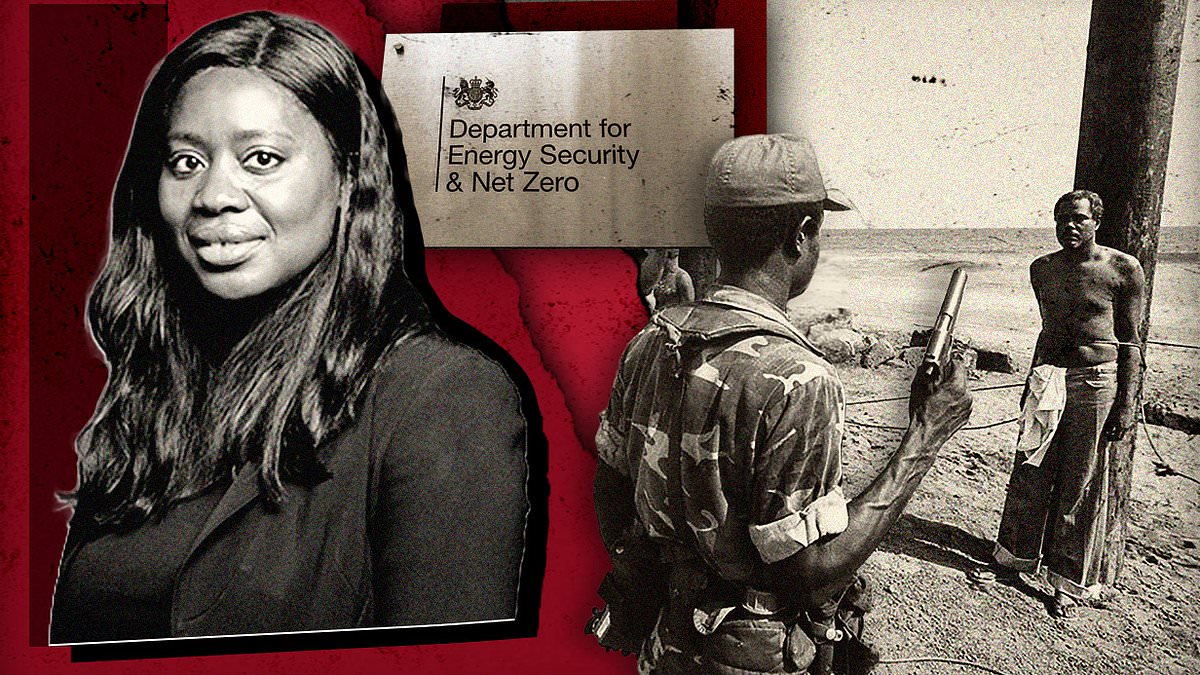
The headline is a chain of verdicts: “Marxist”, “blood-stained”, “African regime”, “executed”, “cannibalised”, and it ends on “Labour star”. Every act in it belongs to the regime. Miatta Fahnbulleh does nothing; she was “forged”. Each label judges before a fact arrives: no country, no year, no role beyond “global envoy”. The collage does the same with pictures, setting her portrait beside her department’s sign and an old photo of a soldier holding a pistol near a bound man tied to a post.
The record, in The Spectator’s profile of October 28: her father was education minister after Samuel Doe’s 1980 coup, in which President William Tolbert was murdered, and foreign minister by 1983, when he was cast out. He fled and organised opposition to Doe from exile in Ghana. The Spectator ties the civil war’s crimes to Charles Taylor and George Boley’s Liberia Peace Council, says the Truth and Reconciliation Commission did not sanction him, and quotes him unrepentant: “as young militants we owe no apologies”.
The habit the sentence rides: their act is their nature, so a stranger’s government becomes his kind, and his kind becomes his daughter. That is Essentialization, the stage where a person becomes her category, here by bloodline. The tell is the person who does nothing in her own headline, placed after the worst words. When it works, her critics have a case without a word about energy. The Africa Report calls her “The Liberian refugee”: it names the country, and it too makes her origin the story.
The words. “Global envoy” is the headline’s title for him. The Spectator says foreign minister, and before that education minister. An envoy carries a message abroad; a minister sits in the cabinet he later fled.
The timing. The Spectator published its profile October 28. The Mail’s headline is timestamped 12:59 AM GMT on October 31, three days later, and adds “cannibalised”, a word the Spectator piece never uses.
From the book
The six stages of villainization (From Humans To Monsters)
The headline goes past Attribution to Essentialization: a sitting minister is placed by her bloodline, her father’s former government’s worst acts standing for what she was “forged” from.
Chapter 10, The Enemy's Gift
Correlation presented as revelation
Her title and a regime’s executions and cannibalism share one sentence. The headline never says she did anything, and leaves the reader to supply the link.
Chapter 10, The Enemy's Gift
Your move
- The Master Question: you are being made to feel disgust at a woman who appears only as the headline’s last words. Why now? The Spectator’s profile ran three days earlier. Run the Boring Test: two ministries, a 1983 dismissal, exile. Real facts are boring.
- Does it touch you? If you pay a British energy bill, her department’s decisions are on it, judged by what they do. Her father’s 1980s are not. Otherwise it is weather: watch it without bleeding or feeding.
- Your nudge: name which word pulled hardest, “Marxist”, “African” or “cannibalised”, and which belief it pressed on, about Labour or about Africa. The same chain can push another reader to defend her before seeing the record. Question both pulls, including your own.